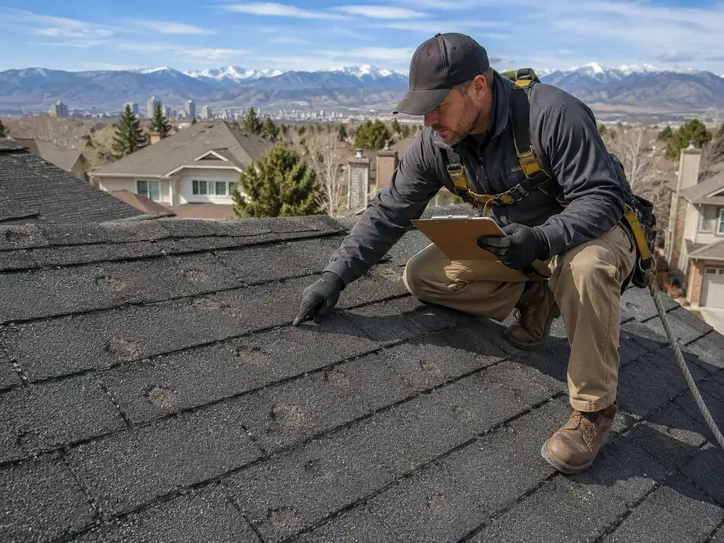
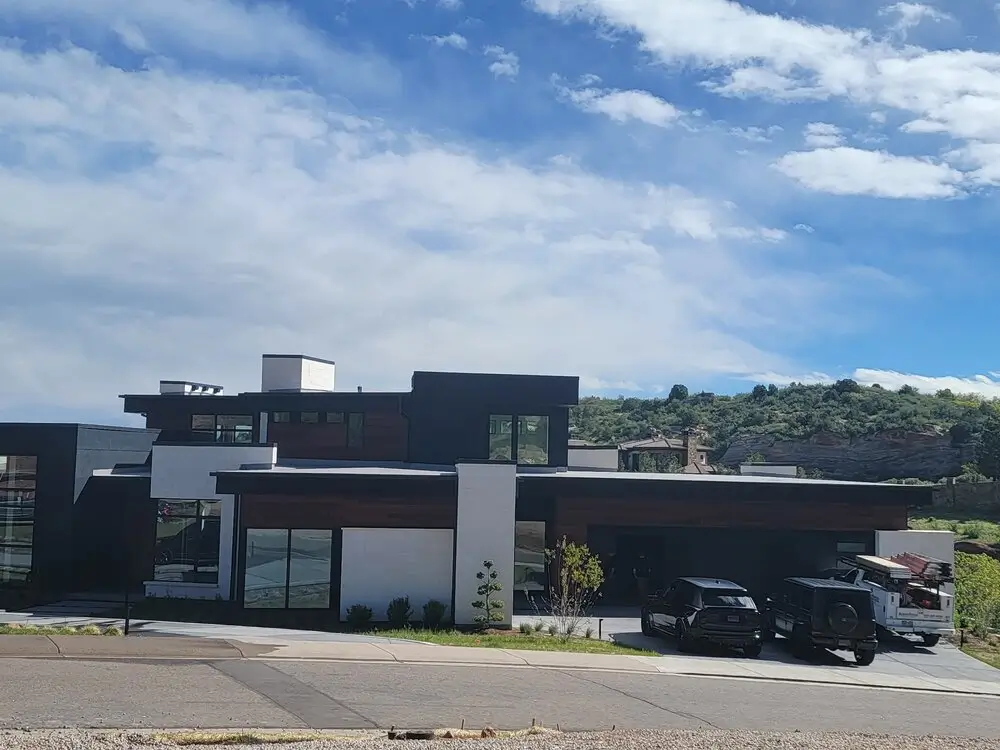
Window replacement in Denver costs an average of $4,777 per project, according to Angi’s 2026 Denver data — but the real range runs from $2,076 to $15,000+ depending on window count, frame material, and whether you go with a big-box installer or an authorized premium brand dealer.
That’s a wide range. And if you’ve already called around for estimates, you’ve probably seen it firsthand: one company quotes $400 per window, another quotes $2,000, and you have no idea which is realistic for your home or why the numbers are so far apart.
This guide breaks down every cost variable — window type, frame material, brand tier, Denver labor premium, Colorado’s 2026 energy code requirements, and available tax credits — so you walk into any estimate conversation knowing exactly what the numbers mean. Our windows and entry doors Denver service page has the brands we carry and install.
TLDR
Window replacement in Denver costs $325–$875 per window for standard vinyl and $700–$2,500+ for premium Andersen or Marvin systems, installed. Denver glazier labor runs 14% above the national median. Most Denver homeowners pay $4,777–$15,000 total depending on window count and material. Colorado’s 2026 energy code (HB 23-1161) requires U ≤ 0.30 on all replacement windows — most quality brands already comply.
Key Takeaways
- Denver window project average: $4,777 (range $2,076–$7,489), per Angi 2026
- Denver glazier labor is 14% above the national median — roughly $53/hr vs. $47/hr nationally (BLS, May 2024)
- Standard vinyl: $325–$875/window installed; Andersen 400 Series: $1,200–$2,500; Marvin Elevate: $1,000–$2,000
- Colorado HB 23-1161 (effective Jan 2026): all replacement windows must achieve U ≤ 0.30
- Federal 25C tax credit: 30% of project cost up to $600/year through 2032 for ENERGY STAR Most Efficient windows
- Denver’s altitude (5,280 ft) and UV intensity affect which frame materials last longest
What Does Window Replacement Cost in Denver in 2026?
In Denver, window replacement costs $325–$875 per window installed for standard vinyl and $700–$2,500+ for premium fiberglass or wood-frame systems from brands like Andersen and Marvin. Denver glazier wages run 14% above the national median — approximately $53/hr vs. $47/hr nationally per May 2024 BLS data for the Denver-Aurora-Centennial MSA — which pushes local installed costs above the national averages most online calculators show.
The Denver-specific numbers tell the real story. Angi’s 2026 Denver data puts the average window replacement project at $4,777, with a range of $2,076 to $7,489. Nationally, Modernize reports $1,047 per window installed based on over one million real projects — but that’s a blended average that doesn’t reflect Denver’s labor market.
How much of your bill is labor? About 15%, or roughly $149 per window on the national average (Modernize, 2026). In Denver, that figure runs higher. And the labor share stays roughly constant regardless of which window brand you choose, so the brand upgrade from vinyl to Andersen isn’t paying for more installation time. It’s paying for a better window.
Here’s how the three cost tiers break down for Denver homeowners:
- Budget ($325–$600/window): Standard vinyl from national chain installers
- Mid-range ($600–$1,200/window): Upgraded vinyl or fiberglass, typically from local installers
- Premium ($1,200–$3,500/window): Andersen 400 Series, Marvin Elevate or Signature
Which tier is right for you? That depends on how long you plan to stay in the home, what Denver’s climate will do to your frame material over time, and whether you’re trying to hit a specific energy code threshold. The sections below break each factor down.
What Type of Window Do You Have — and How Much Does It Cost?
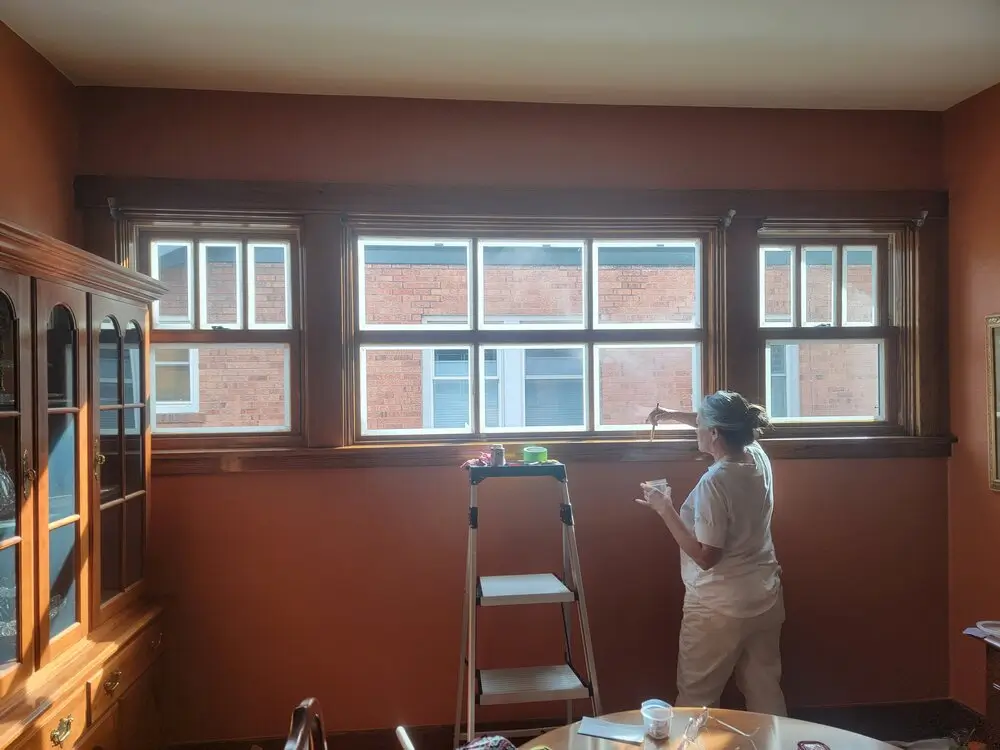
The type of window — double-hung, casement, picture, bay/bow — has the biggest single impact on price after material selection. A standard double-hung replacement averages $495 installed nationally; a bay or bow window runs $791–$886 for a basic unit and $1,500–$3,500+ in the Denver market (This Old House, November 2025 survey).
Here’s how the major window types compare in Denver’s market:
| Window Type | National Avg (Installed) | Denver Est. (Installed) | Notes |
|---|---|---|---|
| Single-hung | $397 | $450–$550 | Simplest operation; common in older Denver homes |
| Picture (fixed) | $419 | $480–$620 | No moving parts; best for mountain views |
| Double-hung | $495 | $550–$750 | Most popular type in Denver |
| Sliding | $507 | $560–$780 | Good for bedrooms and side walls |
| Casement | $560 | $620–$900 | Best seal; excellent for Colorado wind |
| Bay / Bow | $791–$886 | $1,500–$3,500 | Structural complexity adds significant cost |
| Egress (replacement in existing opening) | $700–$1,200 | $900–$1,500 | Basement/bedroom code compliance |
Source: This Old House Nov 2025 survey; Denver estimates adjusted 14% for local labor premium (BLS Denver-Aurora MSA, May 2024)
Why do casement windows outperform double-hung in Denver? A casement’s compression seal runs around the entire frame perimeter, eliminating the gap where the two sashes meet in a double-hung. That gap is where air infiltration happens — and Denver’s freeze-thaw cycles make those gaps worse over time. The $50–$150 premium per casement window is worth it if you’re in a drafty older home or one that gets consistent westerly wind exposure.
One note on egress windows: full egress installation — cutting a new opening — averages $4,216 nationally (HomeAdvisor). Replacement within an existing opening, which most basement window projects involve, is the $700–$1,500 range shown above.
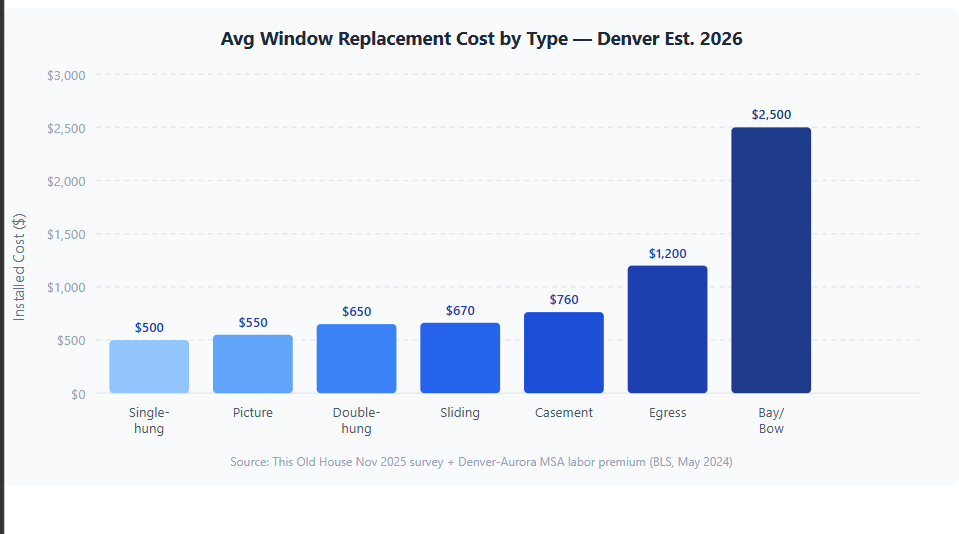
Source: This Old House Nov 2025 survey + Denver-Aurora MSA labor premium (BLS, May 2024)
Double-hung windows — the most common type in Denver homes — average $495 installed nationally and $550–$750 in the Denver metro with local labor premiums applied (This Old House, November 2025; BLS Denver MSA, May 2024). Bay and bow windows are the highest-cost type at $1,500–$3,500 installed locally due to structural header and framing requirements.
Does Frame Material Matter More in Denver Than Other Cities?
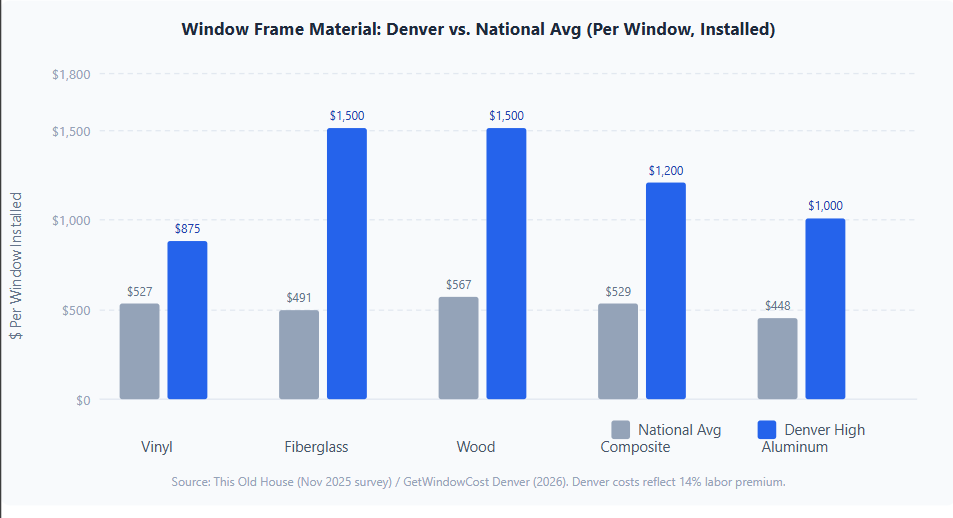
Frame material is the second-biggest cost driver — and the decision that matters most long-term in Denver. Vinyl averages $527 per window nationally ($325–$875 Denver installed) but can degrade in as few as 12–15 years in Colorado’s UV-heavy conditions. Fiberglass runs $700–$1,500 Denver installed and lasts 30–50 years. That lifespan difference often makes fiberglass the better lifetime value, even at twice the upfront cost.
Here’s how the major frame materials compare:
| Frame Material | National Avg | Denver Range | Lifespan in Denver | Best For |
|---|---|---|---|---|
| Vinyl | $527 | $325–$875 | 12–20 yrs | Budget, rentals, standard homes |
| Fiberglass | $491 avg / $500–$1,500 range | $700–$1,500 | 30–50 yrs | Premium performance, UV resistance |
| Wood (clad) | $567 avg / $700–$2,000 range | $800–$1,500 | 30–50 yrs | Historic Denver homes, aesthetics |
| Composite | $529 avg | $600–$1,200 | 25–40 yrs | Mid-range with wood appearance |
| Aluminum | $448 avg | $500–$1,000 | 20–30 yrs | Commercial applications, modern design |
Source: This Old House Nov 2025; Lifespan estimates: DMD Builders 2025
Denver receives nearly 300 sunny days per year, and UV radiation at 5,280 ft is approximately 10–12% more intense than at sea level (EPA, via KOAA Weather 2025). In our experience, this accelerates degradation of vinyl frames — particularly caulking, weatherstripping, and color stability — below the manufacturer’s rated lifespan. A rated “20-year vinyl window” from a national chain often shows significant weathering at 12–15 years in Colorado conditions. Fiberglass and composite frames, like Andersen’s Fibrex material and Marvin’s pultruded fiberglass, hold up significantly better against Colorado’s UV load.
So what does that mean for the math? A vinyl window at $600 installed that needs replacement in 14 years costs you $43/year. A fiberglass window at $1,100 installed that lasts 40 years costs you $27.50/year. The premium window wins on lifetime cost in Denver’s climate, even before accounting for energy savings.
At Denver’s altitude, we specify windows without argon gas fill for most projects. Here’s why: the pressure differential at 5,280 ft creates approximately 1,100 lbs of outward force on a standard insulated glass unit — enough to accelerate seal failure and argon gas loss over time. Altitude-adjusted IGUs or factory-specified capillary tubes solve this problem, but it’s a specification detail most national brands and big-box installers don’t account for in Denver. Always ask your installer how they handle altitude specification before you sign anything.
Source: This Old House (Nov 2025 survey) / GetWindowCost Denver (2026). Denver costs reflect 14% labor premium.
Denver’s 300 annual sunshine days and UV intensity 10–12% above sea level (EPA) accelerates vinyl frame degradation, shortening a rated 20-year lifespan to 12–15 years in Colorado conditions. Fiberglass and composite frames cost more upfront at $700–$1,500 per window installed in Denver but deliver better lifetime value — 30–50 year lifespans in the same climate (DMD Builders, 2025).
Andersen vs. Marvin vs. Vinyl — What Are You Actually Paying For?
The price gap between a $400 vinyl window and a $2,500 Andersen 400 Series window isn’t arbitrary — it reflects frame material, glazing technology, hardware grade, warranty length, and installer certification. Here’s what each tier actually delivers for Denver homeowners. See our windows and entry doors Denver service page for the brands we install.
| Brand / Tier | Installed Cost (Denver) | Frame Material | Best For |
|---|---|---|---|
| Standard vinyl (national brands) | $325–$600 | Vinyl | Budget replacement, rentals |
| Andersen 100 Series | $500–$900 | Fibrex composite | Step-up from vinyl |
| Andersen 200 Series | $700–$1,200 | Vinyl (white only) | Mid-range, energy efficient |
| Andersen 400 Series | $1,200–$2,500 | Wood interior / aluminum clad | Denver primary homes |
| Marvin Essential | $700–$1,200 | Fiberglass (pultruded) | Great UV/lifespan value |
| Marvin Elevate | $1,000–$2,000 | Fiberglass + wood interior | Custom color, high performance |
| Marvin Signature | $1,400–$2,500 | Solid wood + aluminum clad | Architecturally distinctive homes |
Source: Modernize brand comparison, February 2026; Denver pricing adjusted from installer market data
Both Andersen and Marvin’s standard product lines meet Colorado’s 2026 U ≤ 0.30 energy code with standard dual-pane low-E configurations. You don’t have to buy the premium tier just to pass code. But the “30-year window vs. 15-year window” question is where the real lifetime cost math favors premium brands in Denver’s UV-heavy climate.
The other factor worth knowing: both brands are available only through authorized dealers. You can’t buy an Andersen 400 Series or a Marvin Elevate at a big-box store and have it installed by a national chain. The pricing transparency you get from an authorized dealer — with a line-item quote by product series, glazing package, and installation scope — is something you can’t get from a general quote.
See our windows and entry doors Denver service page for the brands we carry and install.
Does Colorado’s 2026 Energy Code Affect Which Windows You Can Buy?
As of January 1, 2026, Colorado law (HB 23-1161) requires all residential replacement windows to meet a U-factor of ≤ 0.30 — the amended IECC 2024 standard for Colorado’s climate zone. This affects what products your installer can legally sell, and it should show up on every compliant quote you receive.
What does U-factor mean in plain language? It measures how much heat passes through the window assembly. Lower numbers mean better insulation. A U-factor of 0.30 is the Colorado floor — nothing above that qualifies for a legal replacement installation on a residential structure three stories and under.
A few specifics worth knowing:
- What this rules out: Single-pane windows, older aluminum-frame products without thermal breaks, and any non-NFRC-rated product
- What qualifies: All current Andersen and Marvin product lines; most ENERGY STAR certified products
- Historic exceptions: Historically designated Denver structures may qualify for exemptions — check with Denver Community Planning and Development
- How to verify: Ask for the NFRC label on every window — it lists U-factor and SHGC from independent testing
How do you verify a window meets the code before you buy? The NFRC label is your answer. Every code-compliant window carries a label showing its U-factor, Solar Heat Gain Coefficient (SHGC), and other ratings from independent testing. No label, no compliance.
On top of the state requirement, there’s real money available at the federal level. The Energy Efficient Home Improvement Credit (IRS Section 25C) covers 30% of project costs for qualifying ENERGY STAR Most Efficient windows, up to $600 per year through 2032. Replacing old windows with ENERGY STAR certified products lowers heating and cooling costs by up to 13% (EPA, 2024–2025). And the U.S. DOE estimates that poorly sealed windows account for up to 30% of home heating energy loss — which means new windows aren’t just an aesthetic upgrade for most Denver homes.
If you’re already dealing with drafty existing windows, see our guide on cold drafts from windows.
How Much Does a Full-Home Window Replacement Cost in Denver?
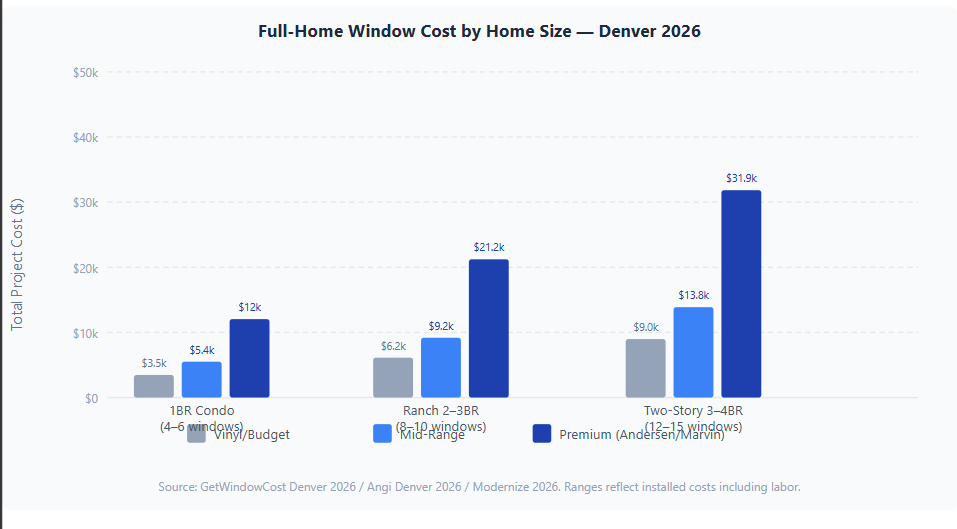
A standard Denver home has 10–15 windows. At Denver pricing, a full-house vinyl replacement runs $4,500–$13,000; a full-house Andersen 400 Series project runs $12,000–$37,500. The 2025 Cost vs. Value report (JLC / Remodeling Magazine) shows vinyl window replacement recoups 68.5% at resale — a $20,091 average project adds $13,766 in resale value.
| Home Size | Typical Windows | Vinyl (Budget) | Mid-Range | Andersen/Marvin Premium |
|---|---|---|---|---|
| 1BR condo | 4–6 | $1,900–$5,000 | $3,600–$7,200 | $6,000–$18,000 |
| 2–3BR ranch | 8–10 | $3,600–$8,750 | $6,400–$12,000 | $11,200–$31,250 |
| 3–4BR two-story | 12–15 | $4,800–$13,125 | $9,600–$18,000 | $16,800–$47,000 |
Source: GetWindowCost Denver 2026 / Angi Denver 2026 / Modernize 2026
Don’t forget the additional costs that don’t show up in the per-window price:
- Window removal and disposal: $50–$150 per window
- Permit fees: $50–$200 for most Denver projects
- Interior trim finishing and paint: varies by scope
- Total adds: typically $100–$300 per window on top of base window costs
What about timeline? Installation runs 30–60 minutes per window. A professional crew installs 10–16 windows per day, so most projects complete in 1–3 days on-site. But plan on 3–6 weeks total from signed contract to completion — fabrication lead times for quality windows run 2–4 weeks, and Andersen and Marvin custom orders can push to 4–6 weeks during peak spring and summer season (Angi, 2025).
If budget is tight and you can’t replace everything at once, start with south- and west-facing windows. These face the most UV exposure in Denver and degrade fastest.
Source: GetWindowCost Denver 2026 / Angi Denver 2026 / Modernize 2026. Ranges reflect installed costs including labor.
The 2025 Cost vs. Value report (JLC / Remodeling Magazine) finds vinyl window replacement recoups 68.5% of project cost at resale — a $20,091 average project adds $13,766 in resale value. Wood window replacement recoups 61.2% ($24,376 average project adds $14,912). Window replacement consistently ranks among the higher-ROI exterior improvement categories.
| Get Your Free Window Replacement EstimateThe Install Company is an authorized Andersen and Marvin dealer serving Denver and the Front Range. We’ll give you a line-item quote — window type, series, frame material, installed cost — so you can compare it against any other estimate apple-to-apple. No surprises, no pressure.Get Your Free Window Replacement Estimate → |
Frequently Asked Questions
How much does window replacement cost per window in Denver in 2026?
Denver window replacement costs $325–$875 per window for standard vinyl, $700–$1,500 for fiberglass, and $1,200–$3,500 for premium Andersen or Marvin systems — all installed. The Denver average across all project types is $4,777 per project (Angi, 2026). Local glazier labor runs 14% above the national median, pushing Denver costs above most national calculator estimates. See our windows and entry doors Denver page for the brands we install.
Does Colorado require specific windows for replacement projects in 2026?
Yes. Colorado HB 23-1161, effective January 1, 2026, requires all residential replacement windows to meet a U-factor of ≤ 0.30. This applies to both new construction and replacement projects on residential structures three stories and under. Historically designated structures may qualify for exemptions. Ask your installer for the NFRC label on every window to verify compliance before work begins.
Are Andersen or Marvin windows worth the extra cost in Denver?
For Denver’s climate, generally yes. Both brands use fiberglass composite or clad-wood frames that withstand Denver’s UV intensity and freeze-thaw cycles significantly better than standard vinyl — which can degrade to 12–15 years in Colorado conditions versus a rated 20+ years. Both also meet Colorado’s 2026 energy code and qualify for the federal 30% tax credit on eligible ENERGY STAR products. If you’re currently dealing with drafty windows, see our guide on cold drafts from windows.
What is the federal tax credit for window replacement in 2026?
The Energy Efficient Home Improvement Credit (IRS Section 25C) covers 30% of project costs for qualifying ENERGY STAR Most Efficient windows, up to $600 per year. The credit runs through 2032. The windows must meet current ENERGY STAR Most Efficient criteria — ask your installer for the specific product NFRC ratings before purchasing to confirm eligibility.
How long does window replacement take in Denver?
Installation runs 30–60 minutes per window; a professional crew installs 10–16 windows per day. Most projects finish in 1–3 days on-site. Total timeline from signed contract to completed installation is typically 3–6 weeks, including 2–4 weeks for window fabrication. Andersen and Marvin custom orders can run 4–6 weeks during peak spring and summer season (Angi, 2025).
Does Denver’s altitude affect window performance?
Yes, in two important ways. First, UV radiation is approximately 10–12% more intense at 5,280 ft than at sea level (EPA), accelerating frame material and caulking degradation — especially on lower-grade vinyl. Second, at Denver’s elevation, windows are typically specified without argon gas fill to prevent pressure-differential failure on insulated glass units. Ask your installer how they handle altitude-specific specifications before you order.
What Should You Do Next?
Here’s what this guide adds up to for Denver homeowners:
- Denver window replacement runs $325–$875 per window (vinyl) to $1,200–$3,500 per window (Andersen/Marvin), installed
- Denver labor runs 14% above national averages — factor this into any online estimate you find
- Colorado HB 23-1161 (effective Jan 2026) requires U ≤ 0.30 on all replacement windows
- Federal 25C tax credit covers 30%, up to $600 per year through 2032, on ENERGY STAR Most Efficient windows
- Denver’s UV and altitude conditions favor fiberglass and composite frames over standard vinyl for longevity
- Full-house project (10 windows): $4,500–$13,000 vinyl; $12,000–$35,000 premium brands
The numbers are real — but they only tell part of the story. Your home’s specific window sizes, existing frame condition, and trim situation all affect the final number. That’s why a line-item estimate matters more than any average.
Ready for an actual number for your home? The Install Company provides free, itemized estimates with no obligation. Contact us here to schedule.
For more on our window and door services, visit our windows and entry doors Denver page. If you’re already dealing with drafty windows while you plan a replacement, our guide on cold drafts from windows covers what you can do in the meantime.
Written by The Install Company Team | Authorized Andersen and Marvin dealer serving Denver and the Front Range | ticcolorado.com