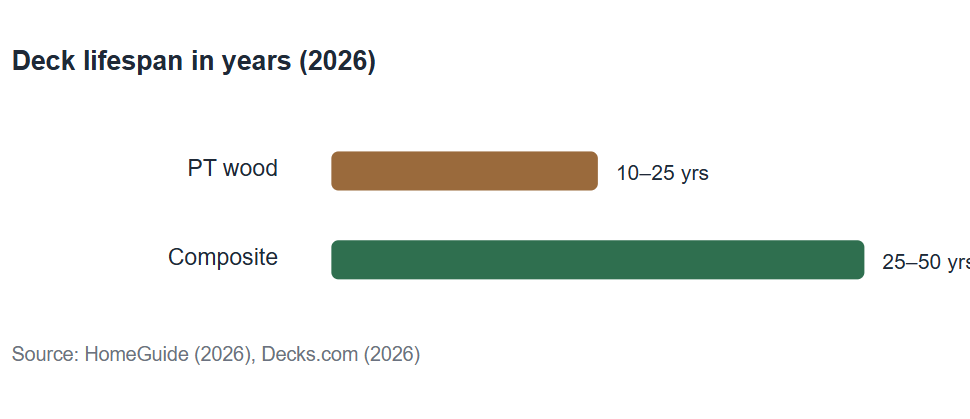
A composite deck can last 25 to 50 years. A wood deck? Closer to 10 to 25, depending on the species (HomeGuide, 2026). That gap is the whole debate in a nutshell — and it’s why “which is cheaper” is the wrong question. The right one is which costs less over the years you’ll actually own the deck.
This comparison lays out 2026 costs, durability in Colorado’s climate, maintenance demands, and resale value, so you can pick with your eyes open.
Key Takeaways
- Composite runs $50–$100+/sq ft installed and lasts 25–50 years; pressure-treated wood runs $40–$80+/sq ft and lasts 10–25 (HomeGuide, 2026).
- Wood needs staining or sealing every 1–2 years (~$400–$600/yr upkeep); composite needs little more than soap and water (~$50/yr).
- Wood deck additions recoup about 83% of cost at resale vs. 68% for composite — but composite’s longer life can win on total cost over time (Remodeling Cost vs. Value, via HomeGuide, 2026).
- Wood still wins on upfront budget and repairability — it isn’t the wrong choice for everyone.
Composite vs. Wood: What’s the Quick Verdict?
For most Colorado homeowners planning to stay put, composite is the better long-term value, while wood is the better upfront-budget pick. Composite costs more to build but can last twice as long with almost no maintenance (HomeGuide, 2026). Wood costs less today but asks for steady upkeep and earlier replacement.
| Composite | Pressure-treated wood | |
|---|---|---|
| Installed cost | $50–$100+/sq ft | $40–$80+/sq ft |
| Lifespan | 25–50 years | 10–25 years |
| Maintenance | Soap & water (~$50/yr) | Stain/seal every 1–2 yrs (~$400–$600/yr) |
| Resale recovery | ~68% | ~83% |
The rest of this guide explains why those numbers land where they do — especially the Colorado-specific parts.
How Much Does Each Deck Cost in Colorado?
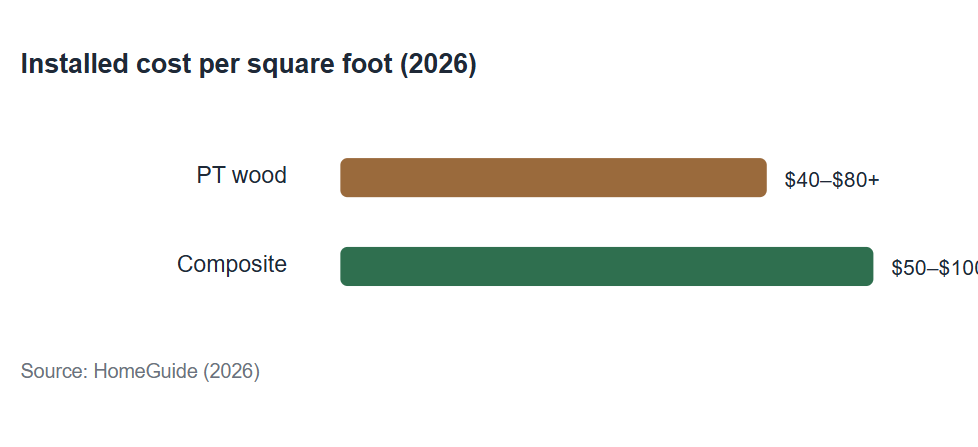
Composite decking costs $50 to $100+ per square foot installed, while pressure-treated wood runs $40 to $80+ (HomeGuide, 2026). That’s a premium of roughly 20–25% upfront for composite — a real gap, but smaller than many homeowners expect.
The sticker price only tells part of the story, though. Wood’s lower entry cost comes with recurring bills for stain, sealant, and labor. Composite’s higher entry cost comes with almost none. We’ll add up the long-term math below.
For a full breakdown of what a deck costs to build here, see our Colorado deck cost guide.
Which Lasts Longer in Colorado’s Climate?
Composite decking wins on lifespan, lasting 25 to 50 years against wood’s 10 to 25 (HomeGuide, 2026). Some composite products are rated for the full 25-to-50-year range and carry warranties just as long (Decks.com, 2026). Our climate is exactly where that durability gap widens.
Why is Colorado so hard on wood? It’s the combination, not any single factor. Intense high-altitude UV bakes and grays the surface. Freeze-thaw cycles work moisture into checks and cracks. Dry air and sudden moisture swings warp and split boards. Composite shrugs off all three — it resists moisture, UV fading, and insects by design.
What Does Each Material Demand for Maintenance?
Wood needs staining or sealing every 1 to 2 years, while composite needs little beyond cleaning a few times a year (HomeGuide, 2026). Annual wood upkeep — staining, sealing, and repairs — runs $400 to $600, against roughly $50 a year in soap and water for composite.
That recurring cost is easy to forget when you’re comparing sticker prices. Over a 30-year timeline, wood’s maintenance costs often exceed composite’s initial price premium (HomeGuide, 2026). On a Front Range deck, that’s a decade-plus of weekends spent sanding and sealing — time most homeowners would rather spend using the deck.
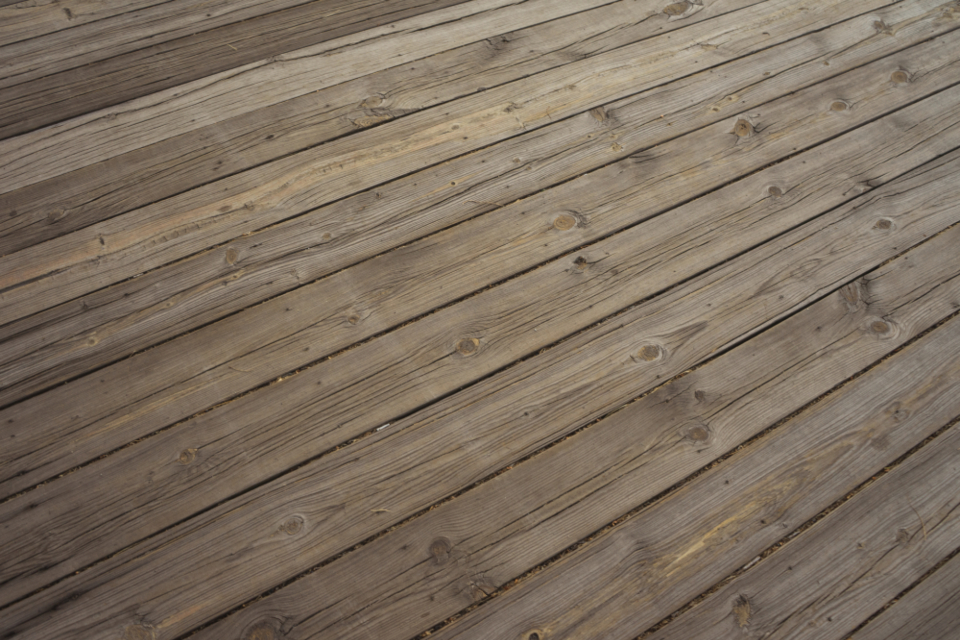
A weathered, graying wood deck showing sun damage
Which Deck Adds More Home Value at Resale?
Here’s a twist most vendors won’t tell you: wood decks actually recoup a higher percentage of their cost. According to the Remodeling Cost vs. Value Report, wood deck additions recoup about 83% of cost, while composite recoups about 68% (via HomeGuide, 2026). Wood’s lower upfront price is the reason the percentage looks better.
So does that settle it? Not quite. Resale percentage isn’t the same as total cost of ownership. A wood deck recoups more of a smaller investment, but you’ll likely replace it once — and stain it a dozen times — within a composite deck’s single lifetime. When we walk a property with homeowners prepping to sell, the low-maintenance composite decks still photograph better and draw fewer repair questions at inspection.
Thinking about the whole outdoor space? Our deck and pergola ideas page shows how decking ties into pergolas and patio covers.
When Does Wood Still Make Sense?
Wood is the right call when upfront budget is tight, you love the natural look, or you don’t plan to stay long. Pressure-treated wood costs less to install than composite, and a real wood deck has a warmth some homeowners simply prefer (HomeGuide, 2026).
Wood is also easier and cheaper to repair board-by-board. A damaged plank swaps out without matching a discontinued composite color. If you’re handy and don’t mind the maintenance rhythm, wood can be a perfectly smart, budget-conscious choice. It isn’t a downgrade — it’s a different set of trade-offs.
Our Recommendation for Front Range Homeowners
For most Front Range homeowners staying five-plus years, we recommend composite, because Colorado’s UV and freeze-thaw cycles make wood’s maintenance and shorter lifespan add up fast. The higher upfront cost buys two decades-plus of low-effort use.
Choose wood if the budget demands it or you’re selling soon. Choose composite if you want to build once and enjoy it. Either way, the build quality matters as much as the boards — proper footings, flashing, and framing are what keep any Colorado deck level and safe. Want a real quote on deck and pergola construction? Call (720) 548-2786 for a free design consult.
Frequently Asked Questions
Is composite or wood decking better in Colorado?
For long-term value, composite — it lasts 25–50 years against wood’s 10–25 in Colorado’s UV and freeze-thaw climate, with far less maintenance (HomeGuide, 2026). Wood wins on upfront cost and is easier to repair board-by-board.
How much more does composite decking cost than wood?
Composite runs $50–$100+ per square foot installed versus $40–$80+ for pressure-treated wood — a premium of roughly 20–25% upfront (HomeGuide, 2026). Composite usually closes that gap over time through lower maintenance and a longer lifespan.
How long does composite decking last in Colorado?
Composite decking lasts 25 to 50 years, and many products carry warranties just as long (Decks.com, 2026). It resists the UV fading, moisture, and freeze-thaw damage that shorten a wood deck’s life in Colorado’s dry, high-altitude climate.
Does a wood or composite deck add more resale value?
Wood recoups a higher percentage — about 83% versus 68% for composite — per the Remodeling Cost vs. Value Report (via HomeGuide, 2026). But that reflects wood’s lower upfront cost; composite’s longer life and minimal upkeep often win on total cost of ownership.
How often do you have to stain a wood deck in Colorado?
Every 1 to 2 years, due to intense high-altitude UV and freeze-thaw cycles. Annual wood upkeep runs $400–$600 for staining, sealing, and repairs (HomeGuide, 2026). Skipping it accelerates graying, cracking, and rot in Colorado’s dry, sunny climate.
The Bottom Line
In Colorado, the composite-versus-wood choice comes down to time. Staying put for years? Composite’s longer life and easy upkeep make it the better value despite the higher upfront cost and lower resale percentage. Tight budget or selling soon? Wood is a fair, lower-cost option that’s simpler to repair.
Match the deck to how long you’ll own it and how much weekend maintenance you’ll tolerate. When you want a real number for your space — in either material — call (720) 548-2786 or request a free deck consultation. We’ve built Front Range decks for over 35 years and we’ll help you choose what’s right for your home.
Sources
- HomeGuide, “Composite Decking Vs. Wood Cost (2026),” retrieved 2026-06-22, https://homeguide.com/costs/composite-decking-vs-wood-cost
- Decks.com, “Composite Decking Price Comparison,” retrieved 2026-06-22, https://www.decks.com/resource-index/decking/composite-decking-price-comparison/