For a Colorado home, the right wooden front door is one built, finished and hung with the state’s dry, sunny weather in mind. Mark Palitto, owner of The Install Company in Denver, wrote this for homeowners from Greeley to Breckenridge who want real wood at the entry. It answers what to settle before you order and what the door asks of you once it hangs.
Key Takeaways
- Pick solid wood for a face you can sand back again and again, or an engineered stile for a frame that moves less.
- Treat any crack or chalky patch in the finish as urgent, because that is where dry air and sun start working on the wood.
- Have every face and edge of the slab sealed before it goes up, then decide between clear varnish for grain and paint for sun protection.
What’s the difference between solid, engineered stile and veneer wood doors?
The difference is what sits under the face you see.
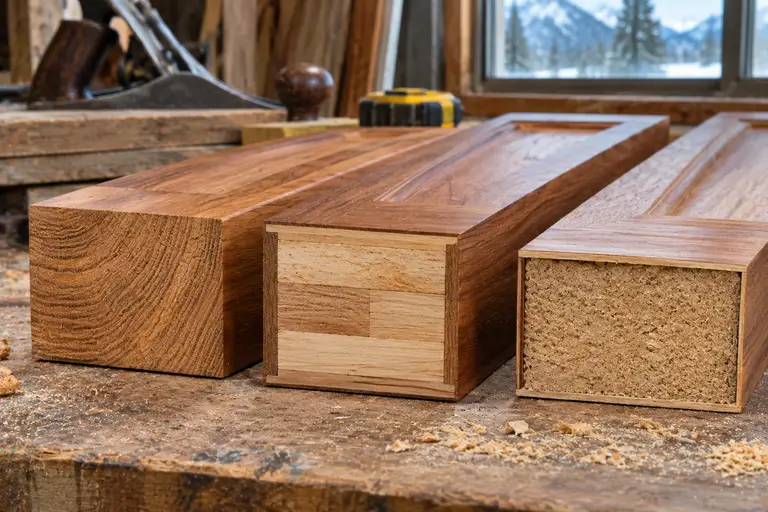
- Solid wood: every frame piece and panel is cut from full lumber. It shows the deepest grain and takes repeated sanding and refinishing, but solid lumber moves more as its moisture content changes.
- Engineered stile: the stiles (the vertical side members) hide a core of laminated wood strips under a hardwood skin. That core keeps tall slabs, such as wood pivot doors, straighter.
- Veneer: a thin hardwood face is glued over a composite or foam core. It costs less, though the thin face allows little sanding.
For a typical price at the solid end, timberandhutch.com, a maker of handcrafted hardwood doors, lists its Beckett door at $4,710 and its Hayden at $5,980. The wood species and the slab size move that number, so a quote for your own opening is how you learn your price. If you are also considering a modern glass entry door, compare the two before you commit to entry door installation.
How do wood doors hold up to dry air, strong sun and temperature swings?
A wood door holds up here as long as its finish stays intact, because dry air and sun reach the wood through that coating. Dry air pulls moisture out, so the wood shrinks and a floating panel can pull back to show a bare strip at its edge. Sun breaks the finish down faster on a door facing south or west, then fades and checks the wood under it. On a winter morning the outside face is cold while the inside stays warm, so the slab can cup and bind in the jamb. So the door belongs on a fall list for getting a home’s exterior ready for Colorado winter.
How should you finish, seal and care for a wood door so it lasts?
Seal every surface, including the top and bottom edges, before the door is hung, so moisture moves in and out of the wood evenly. A clear exterior varnish shows the grain, while paint shields the wood from sun but covers it. After that, care is mostly watching. When the finish looks dull or feels rough, wash the door, sand it lightly and recoat before bare wood shows. Timing depends on the door’s exposure and the product, so ask which coating goes on and when to renew it.
Are wood front doors energy-efficient and secure?
Yes, a wood door can be both, though neither comes from the wood alone. The U.S. Department of Energy’s federal buying guidance advises looking for ENERGY STAR status plus NFRC (National Fenestration Rating Council) ratings for U-factor and air leakage. The Department of Energy’s Federal Energy Management Program calculates that ENERGY STAR-qualified doors save money when priced no more than $2 per square foot (in 2020 dollars) above less efficient models. U-factor measures how fast heat passes through the door, so a lower number keeps more heat inside. Glass inserts change those ratings, so ask for the figures on the exact door you are pricing.
Security depends on the opening as much as on the slab. A solid or engineered door stands up to a kick better than a thin veneer over foam. That holds only if the strike plate and hinges are screwed through the jamb into the framing behind it.
How do you pick a door style and an installer in the Denver area?
Start with the house, then choose the person who will hang the door. The style should suit the home’s architecture: a flat slab with a narrow glass lite (a pane set into the door) fits a mid-century ranch, while raised panels sit better on a traditional facade. Settle on glass early, since lites and sidelights change how much light reaches the entry and how much of the hall a visitor can see.
For the installer, ask who measures the rough opening (the framed hole the door unit sits in) and who orders the door, so one person answers for the fit. Ask whether the quote covers the jamb, threshold and trim, or the slab alone. The Install Company is based in Denver and works across the Front Range from Castle Rock to Greeley, as well as in mountain towns such as Breckenridge and Aspen.
Why do homeowners still choose real wood for the front door?
Real wood gives an entry grain and weight that belong to the material itself rather than to a molded copy. A gouged wood slab can be planed, filled and refinished in place; a door with a thin skin cannot take that repair.
| Wood | Fiberglass | Steel | |
|---|---|---|---|
| Face | Real grain under stain | Molded grain texture | Smooth or embossed, painted |
| Dent or gouge | Repaired in the slab itself | Skin patched | Filled, rarely hidden |
| Odd-sized opening | Built or trimmed to fit | Little trimming | No trimming |
Those strengths show only on a door hung well. ASTM International’s E2112 standard practice sets out installation methods for exterior doors, and an installer of a wood door should follow it.
What drives the installed cost of a wooden front door?
The installed cost comes down to two things: the door unit you order and the state of the opening it goes into. On the door side, the slab type and wood species set the base. Glass lites or sidelights add to it. A door taller or wider than stock sizes has to be built to order, which also raises the price.
Running costs count as well. The Department of Energy’s purchasing guidance notes that energy-efficient doors can reduce the energy a home’s heating and cooling system uses.
For a price on your own entry, contact The Install Company or call 720-764-6264.
Sources
- E2112 Standard Practice for Installation of Exterior Windows, Doors and Skylights, ASTM International, retrieved 2026-10-13.
- Purchasing Energy-Efficient Residential Windows, Doors, and Skylights, energy.gov, retrieved 2026-10-13.
- Exterior Doors, Timber & Hutch, timberandhutch.com, retrieved 2026-10-13.