A screen on your patio door lets you leave the glass open for a breeze without letting bugs in, and getting one to fit and roll straight takes careful measuring plus some adjusting. This guide covers doing it yourself, picking a screen for your door (French doors included), keeping the track smooth, what sets the price and when the door itself is the trouble.
Key Takeaways
- If your door already has an outer screen track, swapping in a new sliding screen is a homeowner job needing only basic hand tools.
- Seat the screen in the top track first, then adjust its rollers so it travels level and stays on the track.
- Clean the grit from both tracks before any lubricant goes on, and finish with a light coat of dry silicone spray.
Can you install a patio screen door yourself?
Yes. Fitting a replacement sliding screen into a track your patio door already has is a job you can do yourself with a tape measure and a screwdriver. A frame that has gone out of square, or a bent or worn bottom track, will keep any screen from rolling true, and fixing that means working on the door rather than the screen. Hinged and retractable screens take more work, since they are fastened to the frame itself. If the door is due for replacement, The Install Company’s guide to what a sliding glass door costs to install lays out the pricing. A screen adds no security, so look at how to secure glass patio doors at the same time.
Steps to measure, hang and adjust a sliding screen so it stays on its track
Measure the opening, hang the screen top first, then set its rollers so it rolls level.
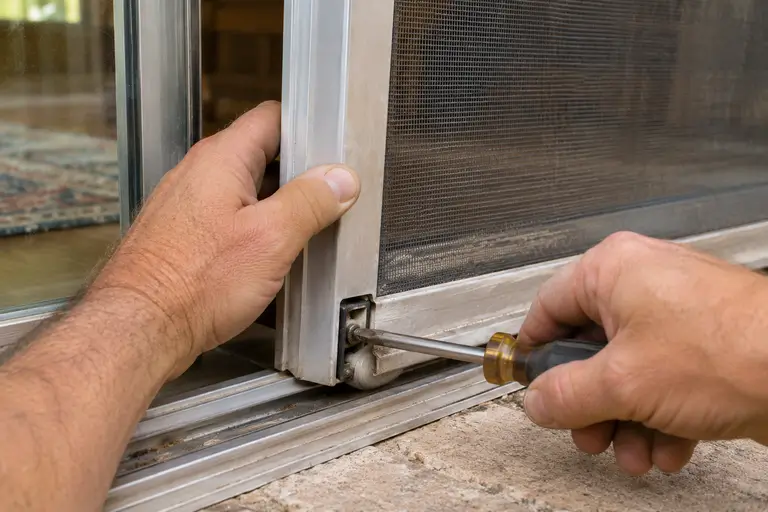
- Remove the old screen: back out the adjusting screw at each bottom corner to pull its rollers up, lift the screen into the top track, then swing the bottom out toward you.
- Measure the height between the tracks at several points and size the screen to the smallest one. Measure the width at the top and bottom of the opening the screen covers, and match the old screen’s width if it closed tight against the jamb.
- Hang it with the bottom rollers retracted: seat the top in the upper track, then swing the bottom over the lower one.
- Adjust each roller screw a little at a time, raising the low corner first, until the screen’s edge runs parallel with the jamb and it stays on the track when tugged.
A dragging glass panel needs new rollers on the sliding glass door, not screen work.
What should you put on the track so the screen and door slide easily?
Put a light coat of dry silicone spray on a clean track. Vacuum the grit out of both the upper and lower tracks first, then wipe them with a damp cloth. Dirt packed into the channel drags the rollers no matter what you spray over it. Aim the silicone at the rail the rollers ride on, and keep it off the screen mesh and the door’s weatherstripping. Skip oil and grease. They stay tacky and hold the dust that blows across a patio, so the track gums up again.
What affects the cost of a patio screen door, bought and fitted?
The price comes down to what the screen is and how much fitting the opening needs. A sliding screen sized to a standard opening costs less than one built to custom measurements, and a hinged or retractable screen adds hardware fastened to the frame. Heavier mesh, such as pet-resistant screening, raises the screen’s price. Fitting costs more when the track or frame needs repair first. When you get a quote, ask whether it covers measuring the opening and hauling off the old screen.
How can you tell the problem is the patio door, not the screen?
Take the screen out and work the glass panel on its own. If the door still sticks, won’t latch, or lets in a draft along the closed edge, the fault sits in the door, and a new screen will not fix it. Look for daylight between the panel and the jamb, or a lock that has to be forced to catch; both point to a panel that has shifted in its frame. Fog trapped between the panes is a failed glass seal, separate from anything the screen does.
Which screen fits your patio door: sliding, hinged or retractable?
The way your door opens decides most of it. A sliding glass door with an outer screen track takes a sliding screen. A French door or other swinging door needs a screen that swings on its own or one that rolls out of the way.
| Screen | Fits | How it moves | Trade-off |
|---|---|---|---|
| Sliding | Sliding doors with a screen track | Rolls in the door’s outer track | Parks in front of the fixed glass panel |
| Hinged | Swinging doors | Opens on its own hinges | Needs clear patio space to swing |
| Retractable | Sliding or swinging doors | Rolls into a side housing | Housing and guides mount on the frame |
If cold air already slips past the closed glass, fix why the sliding glass door lets in cold air before choosing a screen. If you are replacing the door, choose the screen together with the new door, because the track or swing set during our glass door installation decides which screen fits.
How do you add a screen to French or other hinged patio doors?
Start with which way the doors swing, because the screen has to sit on the side the doors don’t open toward. If your French doors swing into the house, the screen mounts on the outside of the frame. That can be a hinged screen door that swings out onto the patio, or a retractable screen fastened to the exterior trim. Doors that swing outward leave only the inside of the frame free, which means a retractable screen mounted indoors.
For a double French door, choose between a pair of hinged screens that meet in the middle and a double retractable that pulls in from each side. Measure the full width across both doors, then check that the trim gives a flat surface for the hinges or housings. Before you drill, close the doors and make sure the screen will clear the handles and locks on that face.
To talk through a screen for your French doors, or a new hinged door to go with one, contact The Install Company or call 720-764-6264.