Keep the door and fix or replace only the frame when the slab (the door panel itself) is still flat and solid; replace the whole door when the slab itself has warped or split. Mark Palitto, owner of The Install Company in Denver, wrote this article for homeowners staring at a soft sill or a sticking entry door and wondering which repair to pay for.
Key Takeaways
- Identify the exact piece of the frame that has failed before asking for quotes, so every installer prices the same repair.
- A sound door is worth keeping, because a carpenter can build the new frame around the door you already own.
- For a hinged entry door choose wood or composite, favoring composite where snow and water sit at the threshold; aluminum frames belong to glass doors.
- Test the frame with a screwdriver at the foot of each jamb: soft wood points to the frame, a bowed slab to the door.
What are the parts of an exterior door frame?
An exterior door frame has four parts: two side jambs, a head jamb across the top, a sill at the bottom and the casing that trims the opening.
- Side jambs: the upright boards on each side. One carries the hinges; the other holds the strike plate the latch catches in.
- Head jamb: the horizontal piece that ties the side jambs together over the door.
- Sill: the sloped bottom piece, often sold as the threshold, that sheds water outward and seals under the door.
- Casing: the trim inside and out that covers the gap between the jambs and the wall framing.
The sill is easy to leave off a parts list. A poster on a WoodNet forum thread about exterior door frame replacement paid $53 for a PVC frame, then made a second trip for a $25 threshold he hadn’t known he needed until the old door was out.
Can you replace just the frame on an exterior door?
Yes. A carpenter can pull the old jambs and sill, then set a new frame around the door you already have, provided that door is still flat, square and solid. Fit is the hard part. The hinge mortises (the shallow pockets each hinge sits in) and the latch hole on the new jambs must line up with the old door, with even gaps all around the slab. Before booking, ask the installer whether they will build the frame to your door or would rather pair it with a new one.
Should an entry door frame be wood, composite or aluminum?
Wood or composite suits a swinging entry door, while aluminum belongs with glass doors, where the frame comes as one unit with the glass. Material also changes the bill: HomeGuide’s front door replacement cost guide counts it among the things that set an entry door’s price.
| Frame material | Where it fits | What to watch for |
|---|---|---|
| Wood | Painted or stained swinging doors, and frames built to an existing door | The sill and lower jambs rot once the paint fails |
| Composite (PVC, or wood fiber bound in resin) | Swinging doors with a wet or snowy threshold | Confirm the jambs hold hinge screws for a heavy door |
| Aluminum | Glass and pivot doors | Made to size with the door and replaced along with it |
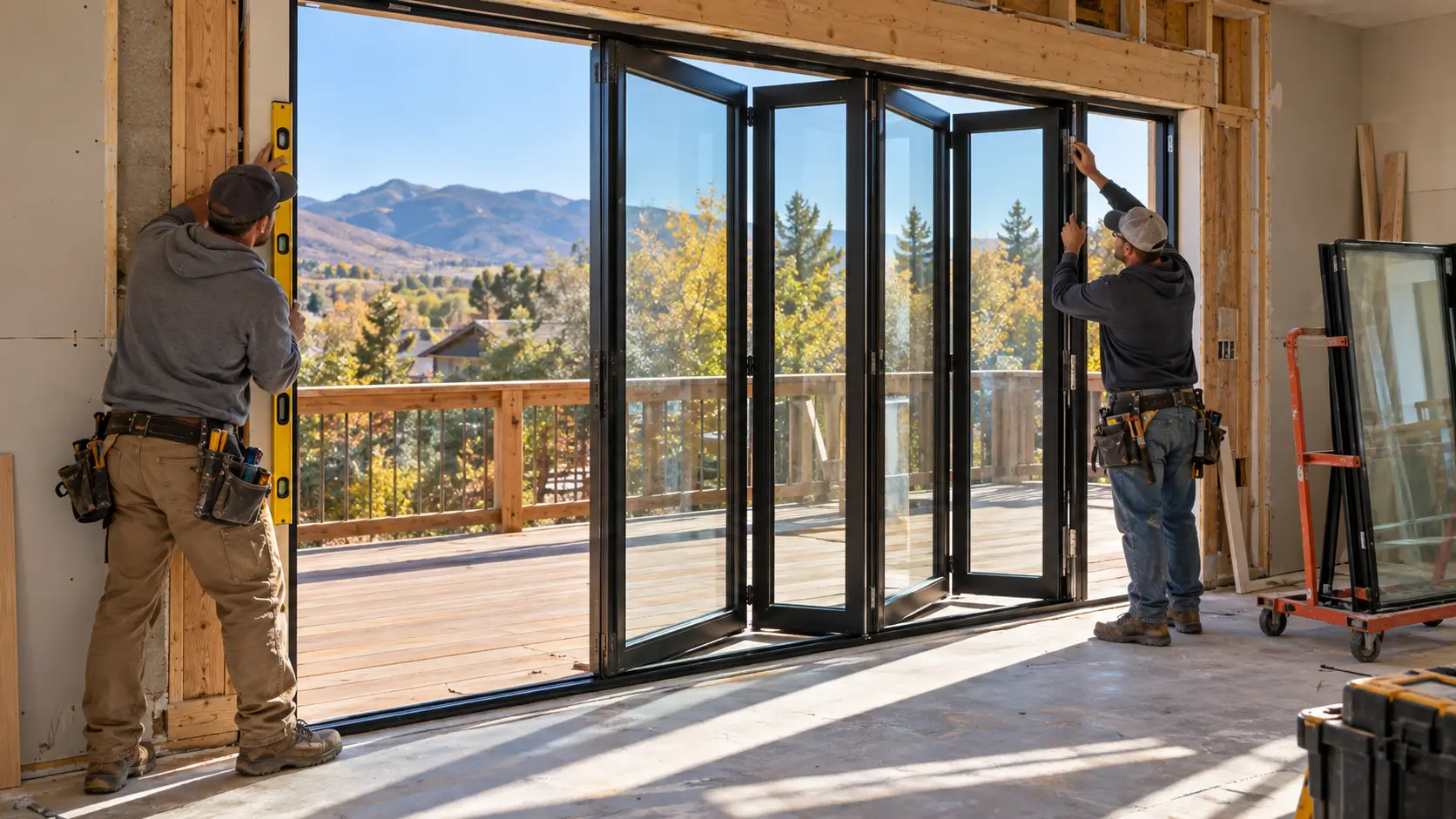
Wood and composite frames fall under our entry door installation work. Glass door installation sets frame and glass together, and a pivot door brings its own frame and hardware. If glass appeals, our article on modern glass entry doors weighs style against security. The guide to big glass doors for Colorado homes covers widening the opening while the old frame is out.
How do you tell if the frame is the problem and not the door?
The frame is at fault when its wood has gone soft or its jambs have moved out of plumb (no longer straight up and down); the door is at fault when the slab itself is warped or split. To check, press a screwdriver into the bottom of each jamb and along the sill. Wood that gives means the frame is failing. Then tighten the hinge screws. A door that still rubs, or a latch that misses the strike plate, points to shifted jambs; a level held against them confirms it.
What affects the cost of replacing an exterior door frame?
Nationally, replacing a door frame typically costs $200 to $550, averaging $400 for a complete installation, according to HomeAdvisor’s door frame cost guide, which separately prices wooden frames at $630 to $780 installed and vinyl, aluminum or fiberglass at $360 to $510. Homeadvisor.com does not say whether that figure includes the material itself. For labor alone, njahc.com’s door replacement cost breakdown gives a typical $100 to $300 per door, without naming a region.
What moves your number is what the old frame hides. A rotting or out-of-plumb frame adds material and labor, and rot that has reached the wall framing must be repaired before new jambs go in. A prehung door comes already hung in its own frame, the better fit when the frame is being replaced anyway; a bare slab costs less but takes more labor to fit. An installer’s quote, given after seeing your opening, is how you learn your own price.
What happens on install day, and how do you choose an installer?
On install day the casing comes off and the old jambs and sill are cut out. The new frame is set on shims (thin tapered wedges) until it stands plumb and square, then fastened to the wall framing. Under the sill, a sloped sill pan flashing with a back dam goes in before the frame and is lapped into the wall’s weather barrier so water drains outward, and sealant is applied as the door maker directs without blocking the front edge of the pan. The door is then hung and adjusted for even gaps before the casing goes back on.
Ask each installer for a written scope that says who hauls away the old frame and whether new casing and paint are included. Ask too how rot found once the jambs are out will be priced, and whether you approve that work before it starts.
Repair the frame, replace the frame, or replace the whole door: how to decide
Repair the frame when the damage sits in one spot. Replace the frame when rot or movement runs through it but the door is sound, and replace the whole door when the slab has failed too.
- Repair: soft wood confined to the foot of one jamb can be cut out and a new piece spliced in, then primed and painted to match.
- Replace the frame: once both jambs or the sill have gone soft, patching one spot leaves the rest still failing, so a new frame goes around your existing door.
- Replace the whole door: a warped or split slab will not close tight against even a new frame, so frame work alone does not fix the draft or the sticking.
To have your frame looked at in Denver or one of the nearby towns we serve, contact The Install Company or call 720-764-6264.
Sources
- How Much Does Door Frame Replacement Cost? (2025 Data), homeadvisor.com, retrieved 2026-10-13.
- How Much Does Front Door Replacement Cost? (2026), homeguide.com, retrieved 2026-10-13.
- Exterior door frame replacement, forums.woodnet.net, retrieved 2026-10-13.
- How Much Does It Cost to Replace a Door? | AHC NJ, njahc.com, retrieved 2026-10-13.